
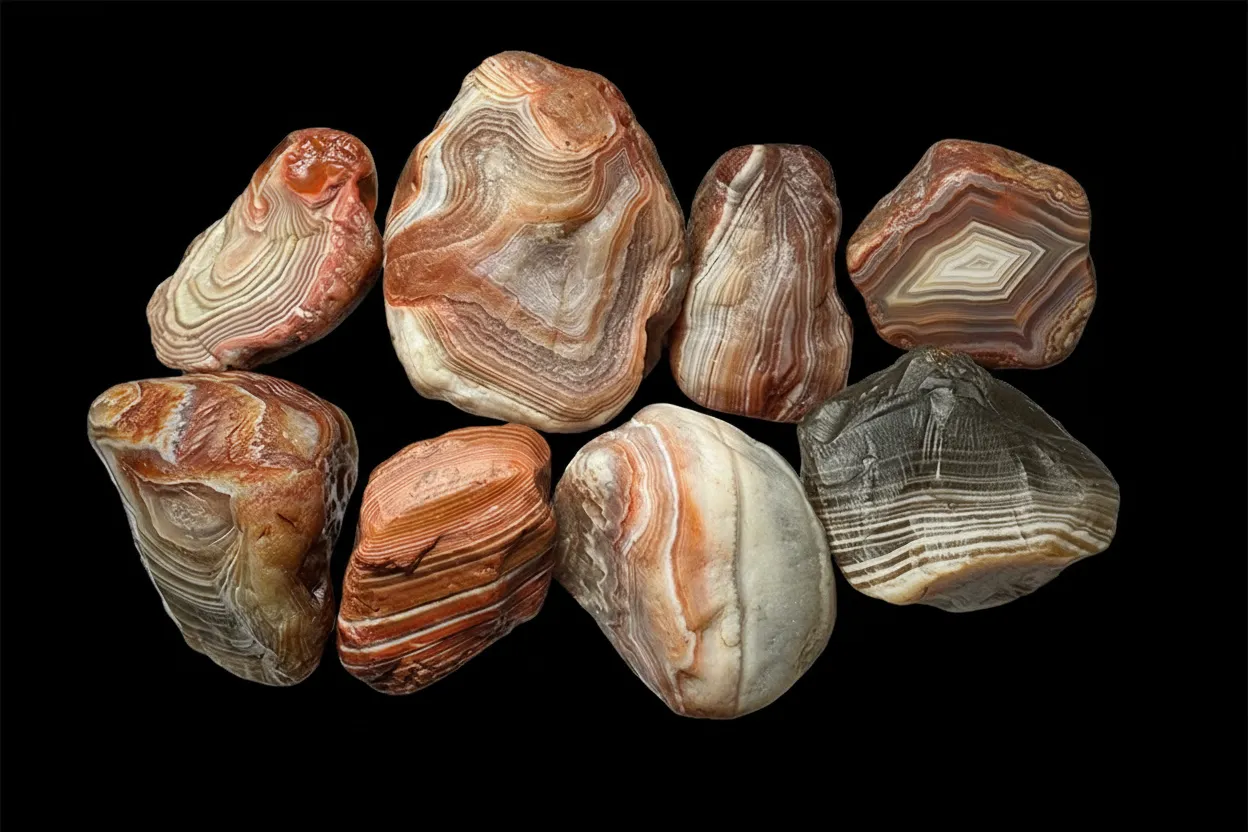
If you've ever picked up a rock that felt heavier than it should, turned it slowly in the light, and felt that quiet spark of *this might be something*, then you already understand Lake Superior agates—even if you didn't pocket one that day.
These stones have a way of changing how you move through the world. Once they teach you how to see, you don't really go back.
Born in Fire, Finished by Time
Lake Superior agates began forming about 1.1 billion years ago during the Midcontinent Rift, when lava flows covered much of what is now the Lake Superior region. Gas bubbles trapped in cooling basalt created hollow pockets. Over immense spans of time, silica-rich groundwater seeped into those voids, depositing layer after layer of chalcedony.
Iron played a starring role. As it oxidized, it produced the deep reds, burnt oranges, soft yellows, and earthy browns that define Lake Superior agates. Each band marks a pause, a shift, or a change in chemistry—making every agate a precise geological record.
They are not dramatic stones in how they're born.
They're deliberate. And it shows.
How They Ended Up Where You Find Them
Most Lake Superior agates are no longer anywhere near where they formed. During the last Ice Age, glaciers scoured the land, ripping agates from their basalt hosts and dragging them hundreds of miles south.
As the ice retreated, agates were scattered across:
That's why you can find one in a creek bed, gravel road, or farm field—sometimes far from water. Each agate you find has already survived volcanoes, crushing pressure, glacial transport, and time on a scale that's hard to comprehend.
Key Characteristics of Lake Superior Agates
Knowing their traits is what separates casual rock pickers from true agate hunters.
Color
Lake Superior agates are famous for iron-rich reds and oranges, but they can also include:
The color is usually strongest internally, which is why cutting or polishing reveals so much hidden beauty.
Banding
Their hallmark feature is distinct banding, created by rhythmic silica deposition. Bands may be tight and sharp or wide and flowing, sometimes numbering in the hundreds within a single stone.
Texture & Feel
Hardness
With a Mohs hardness of about 6.5–7, they're tough stones—resistant to weathering and ideal for lapidary work.
The Most Common (and Loved) Types of Lake Superior Agates
Fortification Agates
These are the classic banded agates, with angular, castle-wall-like patterns. They're often what people picture when they think of Lake Superior agates and are highly prized when bands are sharp and colorful.
Waterline Agates
Recognizable by their horizontal, level bands, waterline agates formed when silica filled cavities in a calm, layered manner. They feel orderly, balanced, and almost meditative to look at.
Eye Agates
Characterized by circular "eye" patterns, these form when silica builds concentrically around a central point. Well-defined eyes are especially collectible and visually striking.
Tube Agates
These feature hollow or quartz-filled tube-like structures formed by rising gas or fluid channels. They can look chaotic on the outside and astonishing when cut.
Moss & Plume Agates
Instead of sharp banding, these contain wispy, branch-like inclusions resembling moss, smoke, or underwater plants. They're softer in appearance and deeply atmospheric.
Quartz-Filled & Crystal-Pocket Agates
Some agates partially or fully crystallize internally, creating sparkling quartz centers. These feel like two stones in one—banded agate and crystal geode combined.
Why the Passion Never Fades
Lake Superior agates don't announce themselves. They reward curiosity, patience, and repetition. They train your eye, slow your pace, and quietly invite you into deep time.
Many collectors will tell you they don't remember the number of agates they've found—but they remember exactly where certain ones came from, who they were with, and how the light hit it when they picked it up.
That's the real magic.
These stones aren't just collected.
They're noticed.
And once you start noticing them, the ground is never just ground again.